





Effective October 1, 2023, all vessels with a beam of 109 feet or more (classified as Neopanamax vessels) transiting the Panama Canal must have a fixed piloting unit equipped with Real-Time Kinematics (RTK) for submeter accuracy. This requirement aims to enhance the canal's efficiency by eliminating delays caused by the installation of portable piloting units (PPU-RTK).
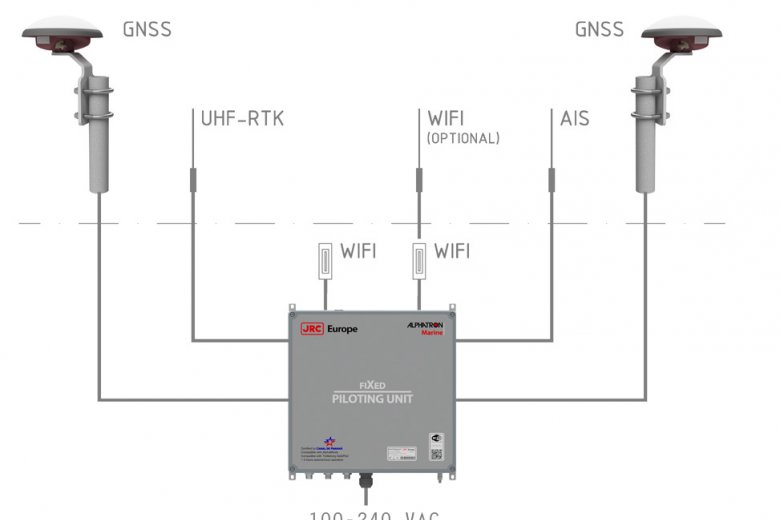
JRC offers a cutting-edge solution featuring the latest Global Navigation Satellite System (GNSS) technology. The JRC Europe Fixed Piloting Unit, approved by the Panama Canal Authority, seamlessly integrates with the pilot’s tablet and software via a wireless network once installed and powered. Designed for reliability, the Fixed Piloting Unit delivers a stable, long-range connection at all conning positions during transit. In the event of a total blackout, it remains operational for at least 5 hours, ensuring uninterrupted performance.
• Full GNSS Precision Antennas
• High gain over the full GNSS spectrum
• State of the art CT-104 GNSS-receiver
• Real time kinematics (RTK) technology
• Dual channel AIS receiver
• UHF receiver for DGNSS corrections
• High accuracy RTK measurement (MRU) with a Gyro Bias Instability ≤1.1°/hr
• Two Wi-Fi antennas for indoor use, optional outdoor antennas available
The Fixed Piloting Unit is equipped with two advanced GNSS receivers, along with AIS and UHF receivers, all housed in a durable enclosure. This standalone unit communicates wirelessly with the pilot's tablet and software via Wi-Fi, using a unique unit ID to provide essential navigation data. Additionally, the main unit includes a power switch and a visual indicator, enabling the equipment to be turned off when sailing outside the Panama Canal. The integrated UPS operates in hot-standby mode, ensuring it remains charged and ready to supply power whenever needed.